
Set 2: Argument Parts
In this set you will be introduced to the key building blocks of arguments: positions, reasons, objections and rebuttals. You'll learn how to map these on a new kind of map that represents how the structure of reasoning goes: a Rationale Reasoning map.

Second page
An argument is a set of one or more reasons or objections bearing upon some claim.
Arguments have a number of key components:
- A position is the main point under consideration. It can also be called the contention, the conclusion, or the issue. We represent a position with a white box:

- A reason provides evidence that another claim is true. Reasons go in green boxes:

- An objection provides evidence that another claim is false. We represent an objection with a red box:

- A rebuttal is an objection to an objection - it aims to provide evidence than an earlier objection is false. We represent a rebuttal with an orange box:
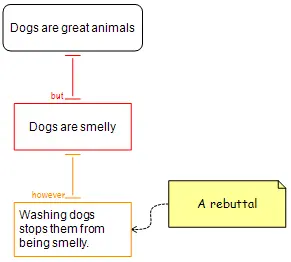
The orange box is generated automatically in Rationale when you add an objection to an objection.
Third page
We can use reasoning maps to show how reasons, objections, and rebuttals fit together in relation to some position.
Consider this train of thought:
Maybe I should go to the beach ... I'd enjoy myself if I went. On the other hand I'm supposed to be at school today. I really enjoy swimming though..
People often think and talk this way, but the structure of their reasoning isn't very clear when we look at it in written form. The piece of reasoning in the box above is fairly short and simple, but imagine how hard it would be to follow if it were ten times longer!
An argument map makes the structure much more clear:
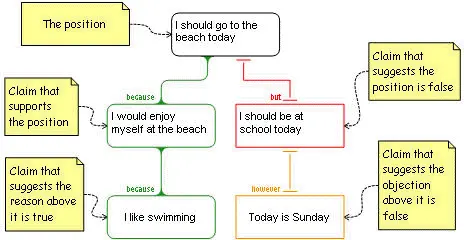
No matter how long the text was, if we had an argument map we'd be able to see at a glance how each claim fitted into the larger pattern of reasoning.
In sets 2-6 you'll be learning how to show the structure of reasoning using Rationale. We'll build your skills step by step, until you're creating your own maps with confidence.
Example
In Set 2 we'll give you a set of claim boxes like these:

We'll also give you a template that shows the pattern of reasoning, like this one:

Your job is to use the claim boxes to build an argument matching the template.
To do that, you'll need to work out what kind of claim each box contains (position, reason, or objection) and where each claim belongs in the logical structure of that argument.
These claims fit into that structure in this way:
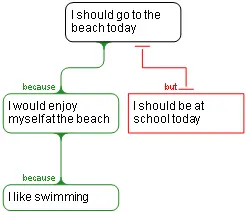
Here's how we arrived at this map.
Exercise 1
Now try this for yourself.
- Make a Rationale Reasoning map of this form:

Use these claims:
Click on the image to open it in the editor. Note: editor will open in a new window.
Hints:
- Change the colors of the boxes to show what sort of claim each is: a white box for the position, a green box for the reason, and a red box for the objection. Make sure you're using the 'box' button and working in Reasoning mode.
- The position is the main point at stake, or the chief issue under consideration.
- The reason is the claim that supports the position by providing evidence that suggests the position is true.
- The objection is the claim that undermines the position, offering evidence to suggest that the position is false.
- Arrange the boxes to replicate the argument template we've provided.
- Check your work against the model.
Exercise 2
- Make a Rationale Reasoning map of this form:

Use these claims:
Click on the image to open it in the editor. Note: editor will open in a new window.
Hints:
- Change the colors of the boxes to show what sort of claim each is: a white box for the position, and green boxes for the reasons.
- Identify the position, which is the main point at stake.
- To work out which reason belongs at which level ask yourself: does this reason provide evidence for the position, or does it support the other reason?
- Check your work against the model.
Exercise 3
- Make a Rationale Reasoning map of this form:

Use these claims:
Click on the image to open it in the editor. Note: editor will open in a new window.
Hints:
- Identify the position. It helps to ask: does this box contain the main issue, or is it a claim that suggests we should believe another claim is true or false?
- Work out which is the upper level objection: this claim directly undermines the position. Turn this claim into a red objection and add it to the map under the position. Work out which is the lower level objection: this claim undermines the other objection. Turn this claim box into a red objection, and when you connect it under the existing objection it will automatically convert to an orange rebuttal box. The remaining claim must be the reason that supports the upper level objection, that is, a reason for thinking that objection is a good one.
- Check your work against the model.
Exercise 4
- Make a Rationale Reasoning map of this form:

Use these claims:
Click on the image to open it in the editor. Note: editor will open in a new window.
Hints:
- Identify the position, which is the main issue at stake.
- Identify the objection. It helps to ask: does this claim suggest that another claim is false?
- Work out which reason belongs on which level. It helps to ask: which gives support to the position, and which gives support to the objection?
- Check your work against the model.
Exercise 5
- Ready for something challenging? Here's a fairly complex map structure:

We'll help you out by identifying the reasons and objections. Your job is to work out where each of the following claims belongs in that map:
Click on the image to open it in the editor. Note: editor will open in a new window.
Hints:
- Identify the top level reason and objection. It helps to look for key words - for example, the word 'chocolate' is in the position, and it appears in three other claims. Two of those claims belong at the level immediately under the position.
- Key words can also help us work out which claims belong to which branches: look for the key word 'cocoa' in one branch, and 'sugar' in the other.
- Check your work against the model.
Final
Congratulations, you have finished Set 2.
Optional information for deeper understanding:
- See the entry Argument in the e-book.
For a more detailed account of various elements of argument, see the e-book: