
Basis Boxes
What's a Basis Box?
A basis box identifies the basis or source of a claim.
We usually support (or oppose) claims with other claims. For example, to support the claim "Mankind will be lucky to see the 22nd century," I might provide another claim such as "Global warming may lead to extinction of the human race within 100 years." But how is that second claim supported? One possibility is to provide a third claim in support - and so on.
It is not practical, however, to go on supporting claims with yet more claims forever. We can, and frequently do, provide support by doing something quite different. For example, we might point to an expert who has made the claim - or to a reputable publication in which the claim appears, or to a quote which backs up the claim.
These other things we point to in support of a claim are bases. Often, but not always, a basis is the source of the claim (e.g., an expert, or a publication).
Types of Basis
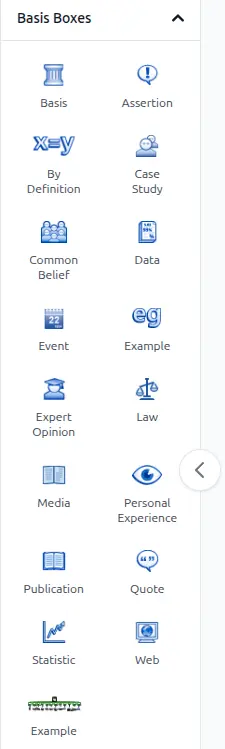
Rationale provides distinctive icons for the common bases listed above, as well as a generic "Basis" icon which you can use for any other kind of basis you might have (see instructions below).
Basis Boxes
In Rationale, basis boxes are where we provide information about the bases for your reasons and objections or the source of your information.
If you hover over each box in the Basis Boxes tab you will see a tool tip. This provides instructions for what to write in the box together with an example. Basis boxes are intended for use in argument maps (reasoning and analysis). You can, however, also add basis boxes to a grouping map. A basis box cannot have another box added below it - after all, it is the basis or foundation for a claim.
Creating your own Basis type
To create your own Basis, drag and drop the generic BASIS box onto the workspace. Double-click and edit the bold heading, [My Basis], typing in your own heading, e.g. "Laboratory Test" or "Eye Witness". To change the image, drag a picture from any .html page onto the existing column image to replace it. You can also use any image saved on your computer. To do this, click on the file icon at the top of the explore pane. An 'open' dialog box will appear. Make sure 'All files' is selected under file types, or the names of your images won't appear in the list of files. Browse to the location where you have stored the file, and click 'open'. Your image will open in the browser window. Drag the image from the browser window onto the existing column image.
You might wish to do this if you're using Rationale to make maps for a specific subject: a legal studies student could make their own "case," "statute" or "legislation" boxes.
Evaluating Basis boxes
You can evaluate a basis to indicate how reliable it is and how much support it gives to the claim above it. Simply select the basis box and choose the option Evaluate on the right toolbar. You can evaluate bases as offering "solid", "shaky" or "nil" support.
Below are some things to consider when determining whether a basis provides "solid", "shaky" or "nil" support.
Assertion
How reliable is the person who made this claim?
- Could that person be mistaken in some way?
- Could they be misremembering?
- Are they in a position to know?
- Is that person impartial? Could they have a reason to lie or misrepresent information?
- How reliable is that person?
- Is the claim something that could count as knowledge, or is it merely someone's personal opinion?
By Definition
- Is the definition clear?
- Does everyone agree with this definition?
- Could two people mean something different by these expressions?
Case Study
- Is the case study relevant?
- Does the case study provide a good basis or analogy for the claim?
- Do the results of the case study concur with the claim being made?
Common Belief
- Is this belief true or is it just a popular opinion, common misunderstanding or stereotype?
- Is this belief really held widely across the whole population?
- Is this belief well founded?
- Is this belief free of serious dispute?
- If the claim is a common generalization, is it true or acceptable in this instance?
Data
How reliable are the data?
- How likely is it that the data could contain errors?
- Could the data have been tampered with?
- Were the data collected using a reliable and appropriate research method?
- Are the data relevant, and do they really support the claim?
Event
- Is the event relevant?
- Who reported the event and are they reliable?
- Does the event support the claim or provide an appropriate analogy?
Example
- How relevant is the example?
- Is one example sufficient to establish the claim? (Sometimes a single example is enough to establish a claim; at other times it isn't.)
Expert Opinion
- Is the expert
- a genuine expert in an area relevant to the claim (i.e. do other experts recognize his or her expertise)? sincere?
- trustworthy and disinterested (i.e. free of conflicts of interest)?
- in a reasonable position to make this claim (e.g. if the claim is a prediction or hypothesis)?
- justifiably confident of the truth of this claim?
- Is the claim seriously disputed by other experts in the field?
Law
- Is this Act or precedent relevant to the claim?
- Has the law been superseded?
- Do the details of the claim in question match the requirements of the law?
Media
- Is this media report reliable?
- Has the media report been manipulated in some way, for example, propaganda or commercial interest?
- Is the media form a genuine information source or does it provide mere gossip and innuendo?
- Does the media information provide a balanced view?
Publication
How reliable is this publication?
- How respected or respectable is the author in the relevant field?
- How respected or respectable is the publisher?
- If the publication is on the internet, is it made available on a reliable institution's website?
- If the publication is a journal, is it refereed or is everyone accepted for publication?
- How recent is the publication? Could the information be out of date?
Quote
- Is this quote genuine, or is the person being misquoted or quoted out of context?
- Is the quote relevant to the claim above it?
- Does the quote really support (e.g. substantiate or illustrate) the claim?
Remember that when you are evaluating a quote as a basis for a claim, you are not just saying, for example, "It's true that this quote was made by Shakespeare in Macbeth"; rather you are saying, "This quote provides solid/shaky/nil support for the claim above".
Statistic
How reliable is the statistical evidence?
- Are the statistics based on reliable data?
- Was the sample used for the statistics sufficiently large and representative of the population about which it generalizes?
- Are the statistics recent?
- Are there other statistics in this area that show very different results? Does the statistic come from a trustworthy, objective, unbiased and disinterested source (i.e. where there is no conflict of interests)? (E.g. who financed the study and why?)
- How big is the leap from the analysis of the data to the conclusion or findings?
- Does the interpretation of the data rely on questionable assumptions?
- If the claim is about a causal link, is there evidence of causation or merely correlation?
Web Resource
- Does the website provide reliable information for the claim being made? (Think about whether it is a .com, .edu or .org address).
- Who operates this website? Are they a credible source?
- Does this website provide balanced views or only one view?
Basis Boxes FAQ
Basis Boxes
What's a basis box?
A basis box provides information about the basis or source for a reason or objection. For example, a basis box may contain a quote, example or publication details for a claim. A basis box may be used to represent the source that someone else provides to substantiate their claim or it may be a source you provide.
You can also determine whether a given basis provides "solid", "shaky" or "nil" support. For example, a statement made by a relevant expert may be considered "solid", while an assertion made by a non-expert may be considered reasonable, though "shaky," or providing only minimal support to the claim it is attached to. An irrelevant quote or one from an unreliable source would be considered as giving "nil" support.
Note that a basis box cannot have another box added below it - after all, it is the basis or foundation for a claim.
You can find more help below and in the Basis Boxes page.
Do you have examples of what you write in each type of basis boxes?
Yes. If you hover over each box in the Basis Boxes tab you will see a tool tip. This provides instruction for what to write in the box together with an example. When you drag out any basis box there will also be ghost 'hint' text telling you what kind of thing to type there. There is also a fun example in the BASIS BOX panel showing basis boxes in action.
Can I make my own basis box?
To create your own Basis, drag and drop the generic BASIS box onto the workspace. Double-click and edit the bold heading, [My Basis], typing in your own heading, e.g. "Laboratory Test" or "Eye Witness". Leave the initial and final asterisks to keep your heading in bold font. To change the image, drag a picture from any .html page onto the existing column image to replace it. You can also use any image saved on your computer. To do this, click on the file icon at the top of the explore pane. An 'open' dialog box will appear. Make sure 'All files' is selected under file types, or the names of your images won't appear in the list of files. Browse to the location where you have stored the file, and click 'open'. Your image will open in the browser window. Drag the image from the browser window onto the existing column image.
You might wish to do this if you're using Rationale to make maps for a specific subject: a legal studies student could make their own "case," "statute" or "legislation" boxes.
Can I use the basis boxes in all maps?
Basis boxes are intended for use in argument maps (reasoning and advanced reasoning). You can, however, also add basis boxes to a grouping map.
When do you use basis boxes?
Use a basis box when you want to provide details of the source or information for a given claim.
Do you evaluate basis boxes?
Yes. For help with this, see the Basis Boxes page.
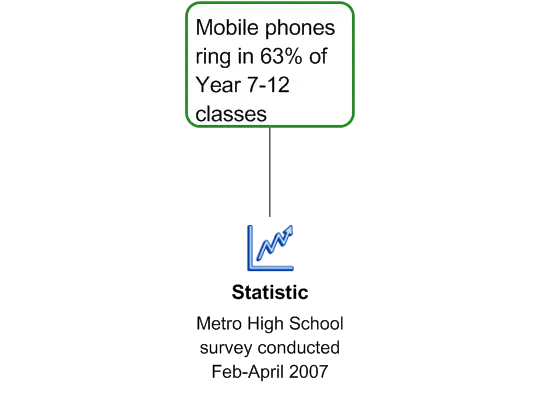
Basis Boxes: Example
Click on the image to open it in the Rationale Editor.
Example: