
Evaluating
What is evaluation?
Introduction
Evaluating an argument is determining the extent to which it justifies believing or denying the contention. In general to evaluate a claim is to decide how confident you are that it is true or acceptable.
Important note: strictly speaking, to evaluate an argument is not determining whether the main contention is true.
Basic principles of evaluating arguments
Analysis makes more sophisticated evaluation available to you, because it makes it possible to evaluate claims and inferences separately.
Whether you should accept or reject the main contention of an argument depends on three things:
Truth of premises
A reason (or objection) can't successfully support (or oppose) a claim if any of its premises are false or dubious. For each and every claim in an argument (whether a premise or the main contention) Rationale enables you to represent three kinds of judgment:

do you Accept the claim as being probably true; or

do you Reject it as being probably false; or

do you mark the claim as dubious because you are not in a position to say one way or the other?
Strength of inferences (linked premises)
A reason offers nil support (and an objection nil opposition) if even one of its premises is unreliable - either false or dubious. So a reason or objection definitely can't do what it's supposed to do (support or oppose) unless all its premises are acceptable.
But having acceptable premises is not enough to establish the success of a reason or objection. In addition, the inference itself has to be valid. Here are some examples where the inferences are not valid (even if though the premises are true):
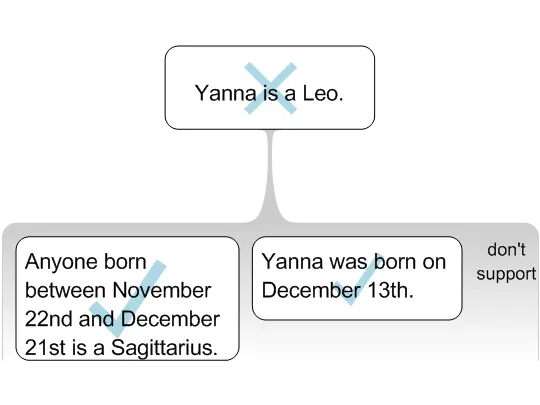
This was meant to be a reason to think that Yanna is a Leo. But as you can see, even though the premises are true, the reason does not support the contention. Even though it appears to be relevant to the claim it's meant to support, it in fact supports a very different conclusion - that Yanna is a Sagittarius, not a Leo. Not only does it not support it, it gives us enough information to know that the contention is false! In other words, it's in fact an objection!
Note that the badness of the reason has nothing to do with the subject matter. I'm rejecting this reason because it misses the mark, not because I don't believe in astrology.
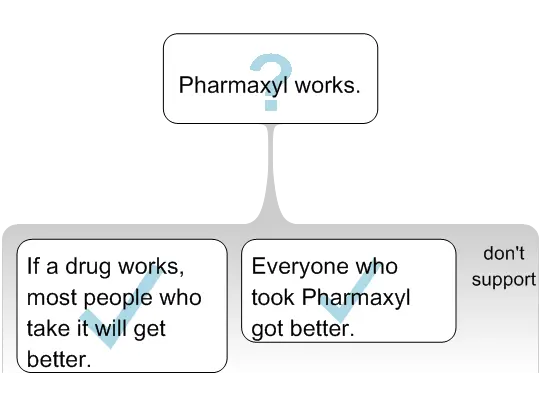
This was meant to be a reason to believe that the drug Pharmaxyl works. The problem with it is that it doesn't give us enough information to conclude whether Pharmaxyl works or not. If the people who didn't take Pharmaxyl also got better, then Pharmaxyl made no difference - the people who took it would have got better anyway.
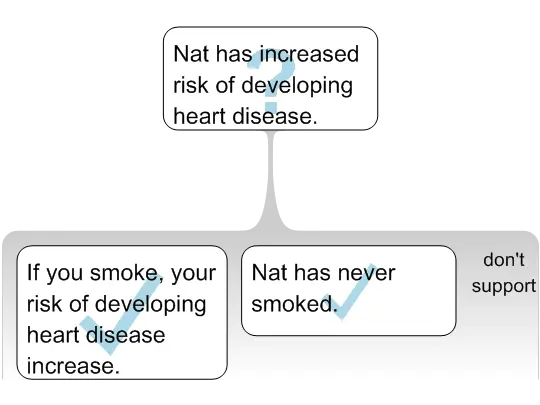
This was meant to be an objection to the claim that Nat has increased risk of developing heart disease; but the objection doesn't work, even though the premises are true.
The objection would have worked if smoking had been the only thing that increases the risk of heart disease; but it doesn't say that. It doesn't say that you'll get increased risk only if you smoke, i.e. that there are no other factors that increase the risk of heart disease. So it doesn't tell us enough to oppose the contention.
As it happens, other things do increase the risk of heart disease. Having high cholesterol, for example, and genetic factors, too, can increase the risk, even if you don't smoke. But you don't need to know this to judge the objection as having no strength. All you need to know is that the objection, the way the premises are worded, does not rule out there being other factors.
Completeness of the case
This is a judgment you have to make before evaluating the main contention of any argument: do you have enough information, or are there any crucial considerations missing from the overall case presented?
Rationale does not give you a means to represent this judgment at this stage; but it's something you must bear in mind when evaluating any argument.
Strength of the case (convergent premises)
A case may consist of a mixture of good and poor arguments on both sides of a debate. By systematically evaluating each argument in turn, you determine which are the good arguments on each side. That enables you to judge whether, on balance, the arguments for the contention are stronger than those against it or vice versa.
Note for philosophers: distinguishing Validity and Soundness
Because Rationale is intended for dealing with real arguments and so evaluation of 'strength' tends to collapse the validity/soundness distinction - and favors soundness (validity plus truth). You can, however, evaluate only the validity of the inferences simply by not evaluating the premises first.
See also:
Advanced Reasoning FAQ
Evaluating FAQ
What is evaluation?
Evaluating an argument is determining the extent to which it justifies believing or denying the contention.
What is the process for evaluating an argument?
Start by reading each branch and follow the line of reasoning down until you reach the last (terminal) box, then evaluate by working up from the terminal box of each branch, one at a time. If the terminal box is a Basis box, determine how good a basis it is for accepting the claim above it. Then consider the next box up - suppose it's a reason - and consider whether this reason provides support for the claim above. This determination of the level of support can be strong, weak or provide nil support.
When you have evaluated this reason, you evaluate the strength of the reason above, given the level of support or opposition below it. (Note that the same rules apply for objections - they aim to oppose another claim - so you must evaluate how well they do this).
The basic principle is that you cannot evaluate a reason or objection until you have evaluated all the reasons or objections bearing upon it. This is referred to as recursive evaluation. When all the primary (or top level) reasons and objections are evaluated you evaluate the contention - which is to decide whether to accept or reject it, given the reasons and objections bearing upon it. Alternatively you may make no stand, which means that you do not have sufficient evidence or reasons and objections to determine whether to accept or reject the contention. In this case, you may need to investigate or request more information (more reasoning) in order to make a decision.

What does the "Clear" section of the evaluate tab do?
The "Clear" section in the "Evaluate" tab allows you to remove the evaluation on a selected box, a map or the entire workspace. Click on the appropriate button, box, map or workspace to make your selection.
What's the difference between "clear across map" and "clear across workspace"?
The "Clear" option clears or removes all evaluations from a selected map or from all maps on the workspace.
- Clear "Map": this relates to removing evaluations on a selected map.
- Clear "Workspace" : this removes evaluation from all maps on your workspace.
Note: If you make an error and clear all evaluations when you only meant to choose the "hide" option, you can choose the undo option. Then choose the settings button and choose the option ‘Show/hide’.
How do I evaluate the strength of each reason/objection?
Als je een bewering wilt evalueren, selecteer je deze en dan kies je voor de knop evalueren in het rechter werkbalk. De selecties voor jouw keuze geven aan of de bewering een reden of bezwaar en ‘sterk’, ‘zwak’ of ‘nul’ is.
To evaluate a claim, select it and choose the button evaluate on the right toolbar. The selections for your choice will reflect whether the claim is a reason or objection, either "strong", "weak" or "nil".
Can I add an already evaluated claim box to my map?
Yes, you can add strong and weak objections and reasons to both reasoning and advanced reasoning maps.
What options are there for showing evaluation?
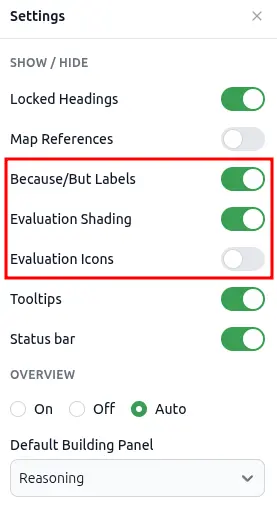
There are three options for how you can display your evaluation. These are located under de settings button, see ‘Show/hide’.
- Because/But labels: In evaluation mode, these indicators will change to "strongly" or "weakly" supports or opposes.
- Evaluation shading: This displays the colour emphasis in the reasoning and advanced reasoning boxes.
- Evaluation markers: These icons provide a further means for you to visually display your evaluation. Strong reasons have two circles and strong objections have two squares. Weak reasons have one filled in circle and objections one filled in square. Reasons with nil support have one unfilled circle and objections with nil support have one unfilled square. To turn the icon features on and off, click on the "Icons" icon.
How do I evaluate the contention?
To evaluate the contention, select the contention box and choose the evaluate button on the right toolbar. Then consider the reasons and objections which support or oppose it and judge whether it should be accepted, rejected, or whether you should take no stand ("Hmmm"). Click on the relevant icon and you will have an icon which represents your judgment.
I cleared my evaluations and want them back. Can I do this?
Yes. If you make an error or change your mind, you can choose the Undo option on the bottom left toolbar.

What's the significance of the dots as evaluation icons?
The evaluation icons or dots are a useful convention to ascertain how well the claim above is supported or opposed. You can think of them as beads, and count them to ascertain the overall weight of each case. Strong reasons have two circles and strong objections have two squares. Weak reasons have one filled in circle and objections one filled in square. Reasons with nil support have one unfilled circle and objections with nil support have one unfilled square. Don't take the 'bead' analogy too seriously. They aren't strictly numerical: two (very) strong reasons (four circles) might weigh more than five (fairly) weak objections (5 squares).
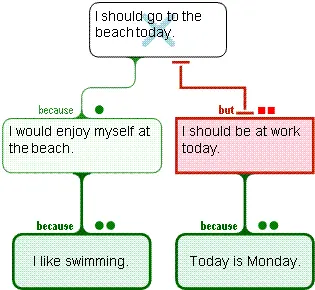
Can you explain to me how evaluation works for advanced reasoning maps?
In reasoning maps you decided if reasons and objections were strong, weak or had no impact upon the claim above. In advanced reasonging maps you evaluate by:
- Determining the truth of a claim or claims within a reason or objection, and then,
- Judge the strength or validity of the reason to the claim above. This means that even if the claims are true, do they give you good reason to believe the claim above? This may seem obvious, however sometimes we have true claims that have no real connection to each other, for instance the reason below has true claims but has no clear relationship to the contention. (This is because one of the key terms "money" is missing in the reason).
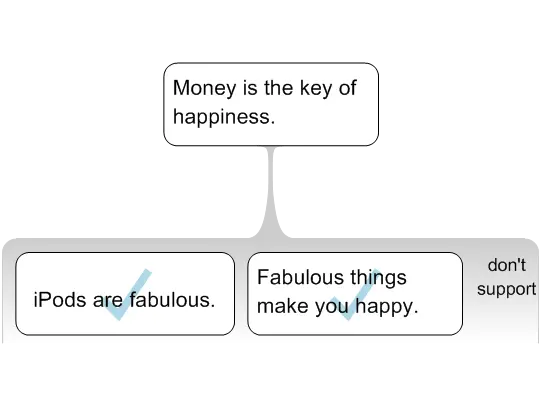
Why do you need to evaluate the basis boxes?
You have the option to evaluate a basis box to indicate how reliable and what level of support it provides the claim to which it is attached. You can evaluate basis boxes as offering "solid", "shaky" or "nil" support. Remember that when you are evaluating a basis box, you are not just saying, for example, "it's true that this quote was made by Shakespeare in Macbeth" rather you are saying " this quote provides solid/shaky/nil support for the claim above."